LINE COMPARISON
Low impedance voltage tester k 60 knopp price
Buyers searching a low impedance voltage tester k 60 knopp price are usually trying to compare a solenoid-style tester with other low-impedance options. LinkScope Sourcing 59 keeps that search as a line on a bill of materials. The desk does not sell a named brand as its own identity, does not publish a street price, and does not treat a catalog photo as proof that the quoted unit is that model.
Line A. Named solenoid form, voltage windows, indicator lamps, lead set.
Line B. Electronic low-impedance tester, stated load, display or lamps, duty.
Line C. High-impedance meter kept off this comparison unless the task needs both.
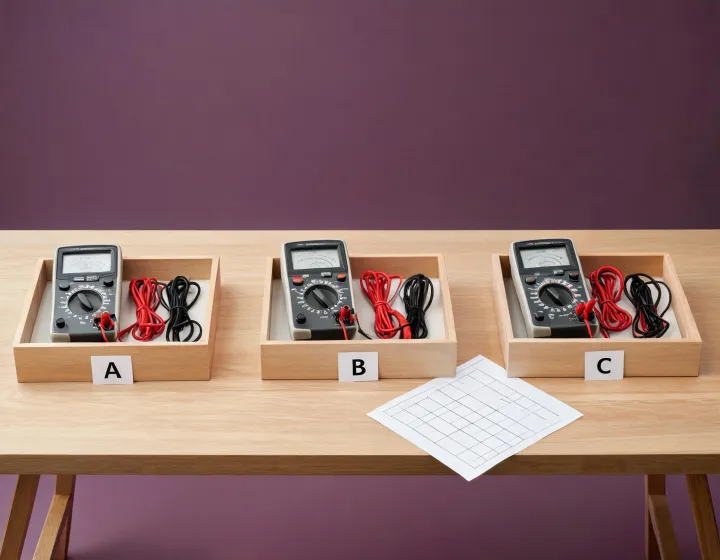
What a comparable low-impedance line must show
A K-60 class instrument is widely discussed as a solenoid voltage tester with a low-impedance movement rather than a 10 MΩ digital input. Before a price is compared, ask the supplier to state the exact manufacturer, model, and configuration. If the offer is an alternative, label it as an alternative. Do not let the search phrase silently become a different electronic pen.
| BOM column | Question for every offer | Open point if unanswered |
|---|---|---|
| Measurement function | Solenoid indication, lamps, or a numeric display | Display type changes calibration evidence |
| Range | AC and DC windows the datasheet lists, such as steps inside 120 V to 600 V | A single 600 V headline hides the steps |
| Impedance | Confirm the low-impedance load, not a 10 MΩ assumption | Ghost-voltage rejection is the reason for this line |
| Duty | Intermittent or continuous, as published for that model | A solenoid is often not a continuous-duty meter |
| Safety category | Marking on the body and the leads, for example CAT III 1000 V or CAT IV 600 V | Leads can be the limiting mark |
| Frequency range | 50 Hz, 60 Hz, and any DC capability | An AC-only movement misses a -48 V DC bus |
| Probe scope | Lead length, fused or unfused, case | Kit price versus body price |
| Measurement accuracy | Required only if a number is displayed | Lamp steps are not a percent accuracy |
Selection trade-offs before an alternative is accepted
OEM-marked solenoid
An OEM-marked tester may follow one factory support route and one datasheet revision. The argument for staying with that mark is simpler traceability when the crew already trains on that form. The argument against is supply concentration if that model is late. Neither argument is a compatibility test. The datasheet still has to match the range and the leads.
Alternative low-impedance model
A different factory may offer another low-impedance tester at another voltage tester price. Accept it only after impedance behavior, duty, safety category, and lead scope are written on the same columns. A lower body price with unrated leads is a deviation, not a match. This mirrors the industry split between OEM-coded and compatible gear: the label is not the proof.
New versus refurbished is the second dispute to keep on the sheet. New stock may offer clearer lifecycle and support. Refurbished stock may be the practical route when a solenoid form is scarce, but condition, lamp age, lead cracks, and calibration traceability must be columns of their own. A refurbished unit does not inherit measurement accuracy paperwork from a new unit of a similar shape.
Background: a buyer had one row labeled with the Knopp search phrase and a second row labeled electronic LoZ from another factory. Process: both rows were forced through the same columns for range, load behavior, duty, CAT marking, and lead fuse status. Result: the electronic offer stayed on the sheet as an alternative because its datasheet showed a different indication method, and the comparison moved to total procurement scope instead of a single unit figure. This is a worked purchasing example, not a recorded customer and not a delivered saving.
Limitations belong in the workflow. Low-impedance testing loads the circuit and can trip sensitive protection or stress a solenoid if the duty is ignored. It does not measure waveform quality, optical budget, or switching capacity. Ingress protection is unknown until the datasheet states it. The workflow also refuses a percentage off claim. No same-scope quotation pair is stored on this site, so no savings figure is calculated.
Standards are question sources. IEC 61010-1 tells you to ask for the measurement category. It does not stamp the unit in the quotation. FCC equipment rules and NRTL marks are requested only when the proposed item is the kind of product those regimes cover. A citation copied from a router file does not travel with a tester.
Keep the product inquiry names and the procurement brief beside the sheet. Then send the filled columns, the quantity in units, the US destination, and the requested timing.
Open points that block a line match
Is a high-impedance digital reading an acceptable substitute?
Not on this line. A 10 MΩ input answers a different question and can display ghost voltage that a low-impedance load would collapse. Put the digital meter on another BOM row if you still need it.
Can the price be compared before leads are named?
No. Lead rating, length, and fusing change both safety category and delivered cost. Hold the comparison until those cells are filled or explicitly excluded.
What if the supplier will not name the model?
Leave the row unmatched. A family name plus the search phrase is not an exact-item offer. Ask again for manufacturer, model, and the datasheet revision date.
Submit the comparison sheet
Copy the filled columns into the requirement field. There is no upload control on this workflow. Optional budget, currency, and per-tester or whole-order basis can be added in the auxiliary fields when script is available. Supplier preference stays a buyer preference.