Project uses that change the purchase lines
Central office DC plant
Background: crews open rectifier cabinets where the bus is about -48 V DC. Process: the brief asks whether any non-contact pen under review detects DC. Most pens state an AC threshold and ignore DC, so the purchase splits a pen line from a contact tester with a DC range. Result: the non contact voltage tester price is not used as the price of the DC check. Measurement accuracy is requested only on the contact instrument that shows a number, together with calibration traceability for that model.
Rack and building power
Before a rack PDU or a 120 V maintenance receptacle is opened, a pen may be the first pass. The second pass is still a contact method matched to the panel. Ask for the safety category, such as CAT III 1000 V when the work is on distribution equipment, and confirm the leads on the contact tester carry the same category. Frequency range should state 60 Hz for a typical US branch, or 50 Hz if the site standard differs. Impedance matters if abandoned conductors in the same tray can show ghost voltage near 10 MΩ inputs.
Outside plant pedestals
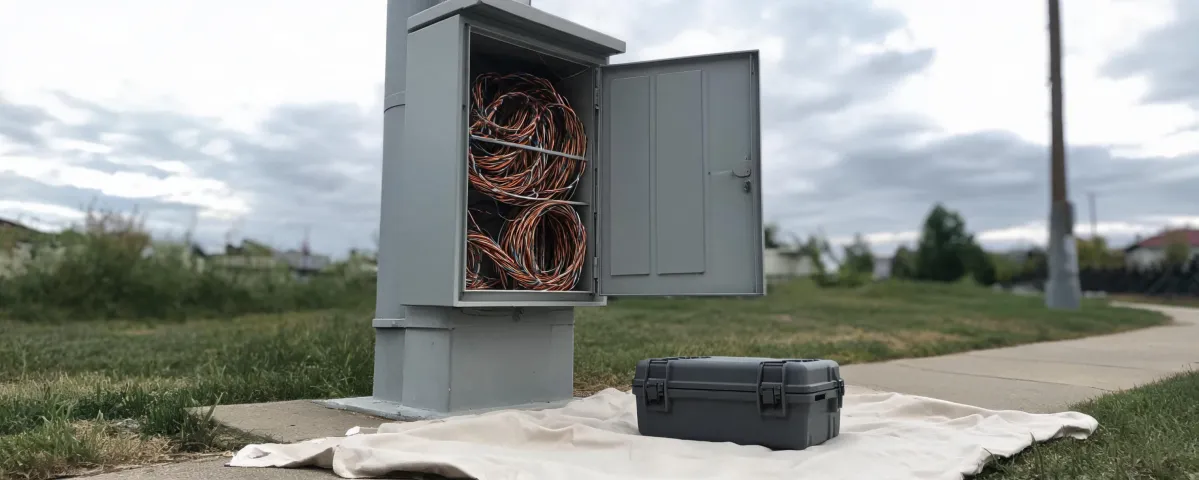
Pedestal work adds rain, dust, and awkward reach. Ingress protection becomes a purchase line when the pen leaves a dry room. A published IP rating, a clip that survives a belt, and a stated detection distance belong in the RFQ. The pen still does not identify which pair is energized inside a bundle. Pair identification stays with the copper or fiber test set named in a different requirement.
600 V distribution near telecom huts
A service-entrance or outdoor distribution point can call for a CAT IV 600 V marking under IEC 61010-1. Write that installation in the brief. Do not let a pocket pen priced for indoor 120 V receptacles stand in for that point. If the contact tester is a low-impedance solenoid, ask for the duty note, because the solenoid is not a continuous-duty meter and it loads the circuit on purpose.
Method trade-offs at the job
High-impedance reading
A digital input near 10 MΩ can show voltage coupled from a neighboring live cable onto an open conductor. That reading is useful when you need to see the coupled voltage. It is a poor sole test when the question is whether the conductor can source current.
Low-impedance load
A low-impedance tester or a solenoid pulls the ghost voltage down. The same load is the wrong tool when the task is a high-impedance measurement or when the circuit cannot tolerate the current the solenoid draws. Ask the supplier for the input impedance or the load current of the exact model.
New versus refurbished applies on every route above. New instruments may carry clearer labeling and a longer support path. Refurbished instruments may fill a gap for an older two-lead form, provided lead condition, CAT print, and any remaining calibration traceability are stated. The desk records the condition the supplier offers. It does not upgrade a refurbished pen into a new one by changing the page title.
Documents to request with the project brief are the current datasheet, the safety category marking, the battery or lead list, and the warranty route. Delivery stages to name are document review, incoming visual check of the marking, and the site acceptance that remains the buyer responsibility. Site constraints include gloves, lockout steps, and whether the pen is only a preliminary indication. Quantity, US destination, and requested timing stay on the same form as the technical lines. Optional budget uses a currency and a per-unit or whole-order basis.
Power over Ethernet is a separate measurement problem. A voltage tester pen does not budget PoE wattage, and a switching capacity figure from a switch datasheet does not describe the pen. If the project also buys switches or optics, keep those families on their own briefs so a non contact voltage tester price is not blended with port pricing.
Start from the inquiry options or the procurement brief, then send the project lines on the contact form. Stock and compliance remain unconfirmed until a supplier names the model.